
Medically reviewed by Dr. Magnus Jayaraj Mansard, Specialist in Liver Transplantation, HPB Surgery and Surgical Gastroenterology. Last medically reviewed on September 2026.
Persistent upper abdominal pain, jaundice, repeated gallstone attacks, pancreatitis, unexplained weight loss, or a newly detected tumour in the liver, pancreas, gallbladder or bile duct can raise an important question: Which specialist should I consult?
These organs are closely connected. A problem that begins in one can sometimes affect another, which is why complex conditions in this region often require evaluation by a Hepato Pancreatico Biliary (HPB) surgeon.
Dr. Magnus Jayaraj Mansard is an experienced Hepato Pancreatico Biliary Surgeon in Chennai with 17+ years of surgical experience. His clinical expertise includes HPB surgery, liver transplantation, surgical gastroenterology, gastrointestinal cancer surgery and advanced laparoscopic surgery.
The goal of an HPB consultation is not simply to decide whether surgery is needed. It is to understand the disease accurately, assess its extent and determine the safest and most appropriate treatment for the individual patient.
What Is Hepato Pancreatico Biliary (HPB) Surgery?
Hepato Pancreatico Biliary surgery, commonly called HPB surgery, is a specialised area of surgery dealing with diseases of the liver, pancreas, gallbladder and bile ducts.
These organs work closely together in digestion and metabolism.
- Hepato refers to the liver.
- Pancreatico refers to the pancreas.
- Biliary refers to the gallbladder and bile ducts.
HPB surgery includes the evaluation and surgical treatment of both benign and cancerous conditions affecting these organs.
Some HPB problems are relatively straightforward, while others involve complex anatomy, major blood vessels or multiple organs. This is why appropriate diagnosis and specialist surgical planning are important.
When Should You See an HPB Surgeon?
Not every episode of abdominal pain or gallstones requires an HPB surgeon. Specialist assessment becomes more important when symptoms, imaging or previous investigations suggest a significant liver, pancreatic, gallbladder or bile duct problem.
Consider an HPB surgical evaluation if you have:
- Persistent or severe upper abdominal pain
- Yellowing of the eyes or skin
- Recurrent gallstone attacks
- Bile duct stones or obstruction
- Repeated episodes of pancreatitis
- A pancreatic cyst or mass
- A liver tumour or suspicious liver lesion
- Gallbladder tumour
- Bile duct tumour
- Unexplained weight loss associated with digestive symptoms
- Abnormal liver tests with a structural abnormality on imaging
- A condition for which liver or pancreatic surgery has been recommended
- A complex HPB diagnosis for which you want a surgical second opinion
Severe abdominal pain, persistent vomiting, fever with jaundice, confusion or rapidly worsening symptoms should be assessed urgently rather than waiting for a routine appointment.
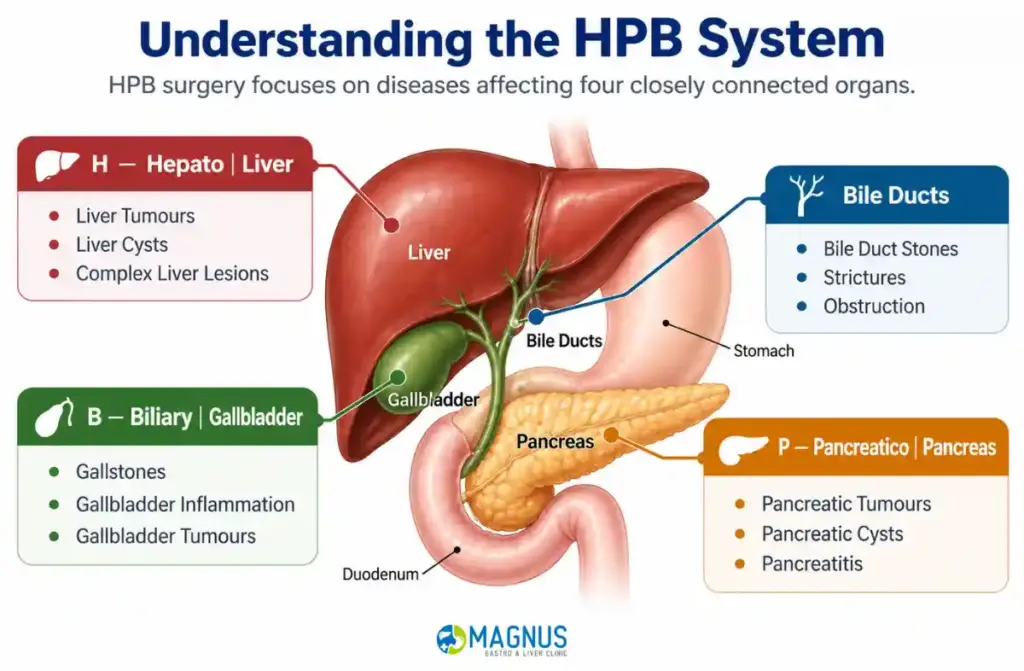
Conditions Treated by an HPB Surgeon
Liver Conditions
HPB surgeons evaluate selected liver conditions that may require surgical treatment, including:
- Primary liver tumours
- Selected metastatic liver tumours
- Liver cysts
- Certain benign liver tumours
- Complex liver lesions
- Advanced liver disease requiring transplant evaluation
Treatment depends on the diagnosis, location and extent of the disease, remaining liver function and the patient’s overall health.
Pancreatic Conditions
Pancreatic diseases can be particularly challenging because the pancreas lies close to major blood vessels, the bile duct and the small intestine.
Conditions requiring specialist assessment may include:
- Pancreatic cancer
- Pancreatic cysts
- Pancreatic tumours
- Chronic pancreatitis
- Complications of acute pancreatitis
- Selected neuroendocrine tumours
Finding a pancreatic cyst or lesion does not automatically mean cancer or surgery. The first step is determining what the lesion is and whether observation, further investigation or treatment is appropriate.
Gallbladder Conditions
Gallstones are common, but their clinical significance varies between patients.
An HPB surgeon may manage:
- Symptomatic gallstones
- Recurrent gallbladder inflammation
- Complicated gallstone disease
- Gallbladder polyps requiring assessment
- Suspected gallbladder cancer
- Complex gallbladder surgery
A patient with an uncomplicated gallstone may require a very different treatment plan from someone with stones involving the bile duct or a suspicious gallbladder lesion.
Bile Duct Conditions
The bile ducts carry bile from the liver toward the intestine. Blockage can result in jaundice, infection and other complications.
HPB surgical assessment may be required for:
- Bile duct stones
- Bile duct strictures
- Bile duct injuries
- Biliary obstruction
- Cholangiocarcinoma
- Complex benign biliary disease
The exact cause of obstruction needs to be identified before treatment is planned.
How Are HPB Conditions Diagnosed?
An HPB diagnosis should not be based on symptoms alone.
The evaluation usually starts with a detailed medical history, physical examination and review of previous reports. Depending on the suspected condition, investigations may include:
- Blood tests: Liver function tests, bilirubin, blood counts and other disease-specific tests can provide important clinical information.
- Ultrasound: Often used as an initial investigation for gallstones, liver abnormalities and bile duct dilatation.
- CT scan: Provides detailed information about the liver, pancreas and surrounding structures and can help assess the extent of certain diseases.
- MRI or MRCP: Particularly useful for evaluating the liver, pancreas and biliary system.
- Endoscopic ultrasound (EUS): May provide detailed imaging of pancreatic and biliary abnormalities and allow tissue sampling in selected cases.
- ERCP: Can be used in selected patients to evaluate and treat certain bile duct problems.
Not every patient needs every test. Investigations should be selected according to the suspected diagnosis and the information required for treatment planning.
Does Every HPB Condition Require Surgery?
No.
This is one of the most important things patients should understand. Being referred to a Hepato Pancreatico Biliary Surgeon in Chennai does not mean that an operation is inevitable.
Some conditions may need:
- Observation and follow-up
- Medication
- Endoscopic treatment
- Interventional radiology
- Oncology treatment
- Surgery
- Liver transplantation
- A combination of treatments
For example, some pancreatic cysts can be monitored rather than removed. Similarly, the management of a liver lesion depends on whether it is benign or malignant, its location and size, liver function and other clinical factors.
The role of specialist evaluation is to determine whether surgery offers a meaningful benefit and, if so, which operation is appropriate.
What Types of HPB Surgery May Be Performed?
The operation depends entirely on the disease.
HPB procedures may include:
- Liver resection
- Pancreatic resection
- Pancreaticoduodenectomy (Whipple procedure)
- Distal pancreatectomy
- Gallbladder surgery
- Complex bile duct surgery
- Surgery for HPB cancers
- Selected minimally invasive HPB procedures
- Liver transplantation
Some operations can be performed using laparoscopic or other minimally invasive techniques, while complex disease may require conventional open surgery.
The safest surgical approach depends on the anatomy, diagnosis, previous operations, disease extent and overall health of the patient.
Why HPB Surgery Requires Specialist Experience
The liver, pancreas and biliary system contain complex networks of blood vessels and ducts and are anatomically connected to several important abdominal organs.
That makes many HPB operations technically demanding. Good surgical planning involves more than removing diseased tissue. The surgeon must also consider:
- The amount of healthy liver or pancreas that can be preserved
- Relationship of the disease to major blood vessels
- Whether nearby organs are involved
- Possibility of minimally invasive surgery
- Nutritional status
- Liver function
- Other medical conditions
- Cancer stage when applicable
- Expected benefits and risks of surgery
This is particularly important in major liver and pancreatic procedures.
Dr. Magnus Jayaraj Mansard – HPB Surgeon in Chennai
Dr. Magnus Jayaraj Mansard is an experienced HPB Surgeon in Chennai with over 17+ years of surgical experience in managing diseases of the liver, pancreas, gallbladder, bile ducts, and gastrointestinal system. His practice includes complex HPB surgery, liver transplantation, GI cancer surgery, and advanced laparoscopic procedures.
Qualifications & Training
MBBS, MS – JIPMER | MNAMS – GI Surgery | MRCS – Edinburgh | FACS | GCSRT – Harvard
His areas of expertise include Hepato Pancreatico Biliary Surgery, liver transplantation, pancreatic and liver surgery, gallbladder and bile duct surgery, surgical gastroenterology, and gastrointestinal cancer surgery.
His experience across gastrointestinal and HPB surgery allows him to evaluate complex conditions where multiple organs may be involved and develop an individualised surgical plan based on the diagnosis, disease extent, and overall health of the patient.

How Treatment Decisions Are Made
For complex HPB disease, the question is not simply:
“Can this be operated on?”
A more useful question is:
“Which treatment offers this patient the best balance of disease control, safety and long-term benefit?”
Treatment planning can involve review of imaging, pathology, liver function, disease stage, surgical fitness and previous treatment.
For cancers involving the liver, pancreas, gallbladder or bile ducts, care may also involve specialists from radiology, medical oncology, gastroenterology, pathology and other disciplines.
This multidisciplinary approach helps ensure that surgery is considered as one part of the overall treatment strategy rather than as an isolated procedure.
Minimally Invasive HPB Surgery
Selected liver, gallbladder and pancreatic operations may be performed using minimally invasive techniques.
Instead of one large incision, laparoscopic surgery uses smaller incisions through which a camera and specialised surgical instruments are introduced.
Depending on the procedure and patient, potential advantages can include:
- Smaller incisions
- Less postoperative discomfort
- Reduced wound-related problems
- Earlier mobilisation
- Shorter recovery in appropriately selected patients
However, minimally invasive surgery is not automatically the best option for every HPB condition.
The priority should be safe and complete treatment. The surgical technique should therefore be selected according to the patient’s disease rather than simply choosing the smallest incision.
HPB Surgery for Cancer
Cancers involving the liver, pancreas, gallbladder and bile ducts require careful evaluation because treatment varies considerably according to the organ involved and the stage of disease.
For example, pancreatic cancer may require a Whipple procedure or another pancreatic operation in selected patients. A liver tumour may require liver resection, transplantation or another treatment depending on its type and extent.
In some cases, chemotherapy or another treatment may be recommended before or after surgery. Therefore, early specialist evaluation and accurate staging are important before deciding on treatment.
What Should I Bring to an HPB Consultation?
If you have already undergone investigations, bringing the complete medical record can help the specialist understand your condition without unnecessarily repeating tests.
Bring:
- Recent blood reports
- Ultrasound reports
- CT or MRI reports
- Actual CT/MRI images when available
- Endoscopy, EUS or ERCP reports
- Biopsy or pathology reports
- Previous surgery records
- Current medication list
- Previous cancer treatment details
Also tell the surgeon about diabetes, heart disease, kidney disease, blood-thinning medications and previous abdominal operations.
Why Early Specialist Assessment Matters
Symptoms such as jaundice, recurrent pancreatitis, unexplained weight loss or persistent upper abdominal pain can have several possible causes. The symptom itself does not identify the disease.
For example:
Jaundice → may indicate bile duct obstruction → imaging identifies the location → further evaluation determines the cause → treatment is selected based on the diagnosis.
Similarly:
Pancreatic lesion → CT/MRI evaluation → determine cyst or solid lesion → assess risk → observation, further testing or surgery depending on findings.
This step-by-step approach helps avoid both unnecessary surgery and unnecessary delay in treating significant disease.
Consult a Hepato Pancreatico Biliary Surgeon in Chennai
If you have been diagnosed with a condition affecting the liver, pancreas, gallbladder, or bile ducts, timely specialist evaluation can help you better understand the condition and available treatment options.
Dr. Magnus Jayaraj, an experienced Hepato Pancreatico Biliary Surgeon in Chennai, provides specialist evaluation and surgical care for complex HPB conditions. Treatment planning is based on the diagnosis, imaging findings, disease severity, overall health, and individual needs of each patient.
Not every HPB condition requires surgery. Some conditions may be managed through monitoring, medical treatment, endoscopic procedures, or multidisciplinary care. When surgery is appropriate, the treatment approach is carefully planned with a focus on safety, disease management, and recovery.
Patients who have been advised to undergo liver, pancreatic, gallbladder, or bile duct surgery, or who need a specialist opinion for a complex HPB condition, can consult Dr. Magnus Jayaraj in Chennai for further evaluation and personalised treatment planning.
Read more: Liver Transplant Surgeon in Chennai